I’ve been turning and carving spoons for several years. I make these spoons from wood that I have riven straight from the logs of native hardwood trees. I finish them with a product called Tried and True, which is a completely food safe finish made from linseed (flax seed) oil and bees wax. If the spoons are washed and dried right away they retain their beautiful grain and color for a very long time. Putting any hand made wooden item in the dishwasher is pretty close to putting it in the wood stove.
two salad serving sets: small – walnut and large – cherry
I make salad serving sets, which have matching handles. One of the spoons is carved into a fork.
This is a picture of my son, James, sitting on a stool that I made for him at Christmas. One day last year he was sitting on a stool that I had just finished. He put his foot on one of the stretchers, a natural thing to do, and remarked that his knee was substantially lower than his hip. He pointed out that if you were playing the guitar while sitting on one of these stools, the guitar would keep slipping away from you. He suggested an extra, higher, rung that would place the thigh parallel to the floor, comfortably supporting the instrument. So I made a “Guitar Picker’s Special” for him. Our musician friend Mark Simonsen helped me get the height correct. This one is made of Hickory and Walnut
Here’s a picture of the stool being dry fitted prior to final assembly, glue-up, and finishing.
I thought I’d just add a bit about my stools. For the most part, I make these stools to order. I make a milking stool which is about the height of a chair (16″ or thereabouts) or, depending on how it will be used, a little shorter.
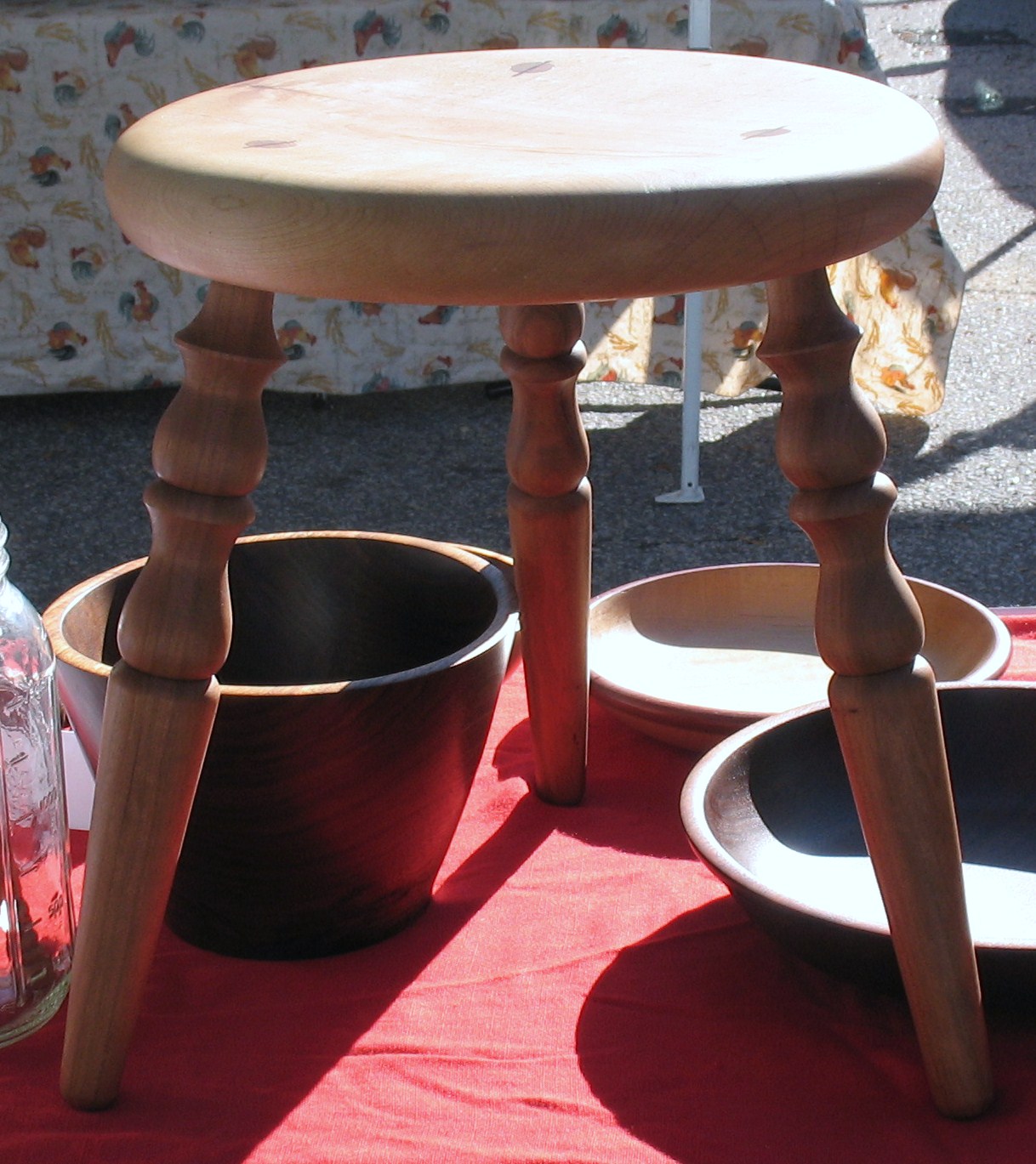
Here’s one of the milking stools shown at the Wake Forest Farmer’s Market
The taller stools begin at about 20 or 21″ tall and can be made up to 29″ tall. I use a variety of domestic hardwoods to make the stools, and I often combine different woods in order to contrast the colors and grain patterns. I vary the turnings on legs and stretchers to add visual interest.
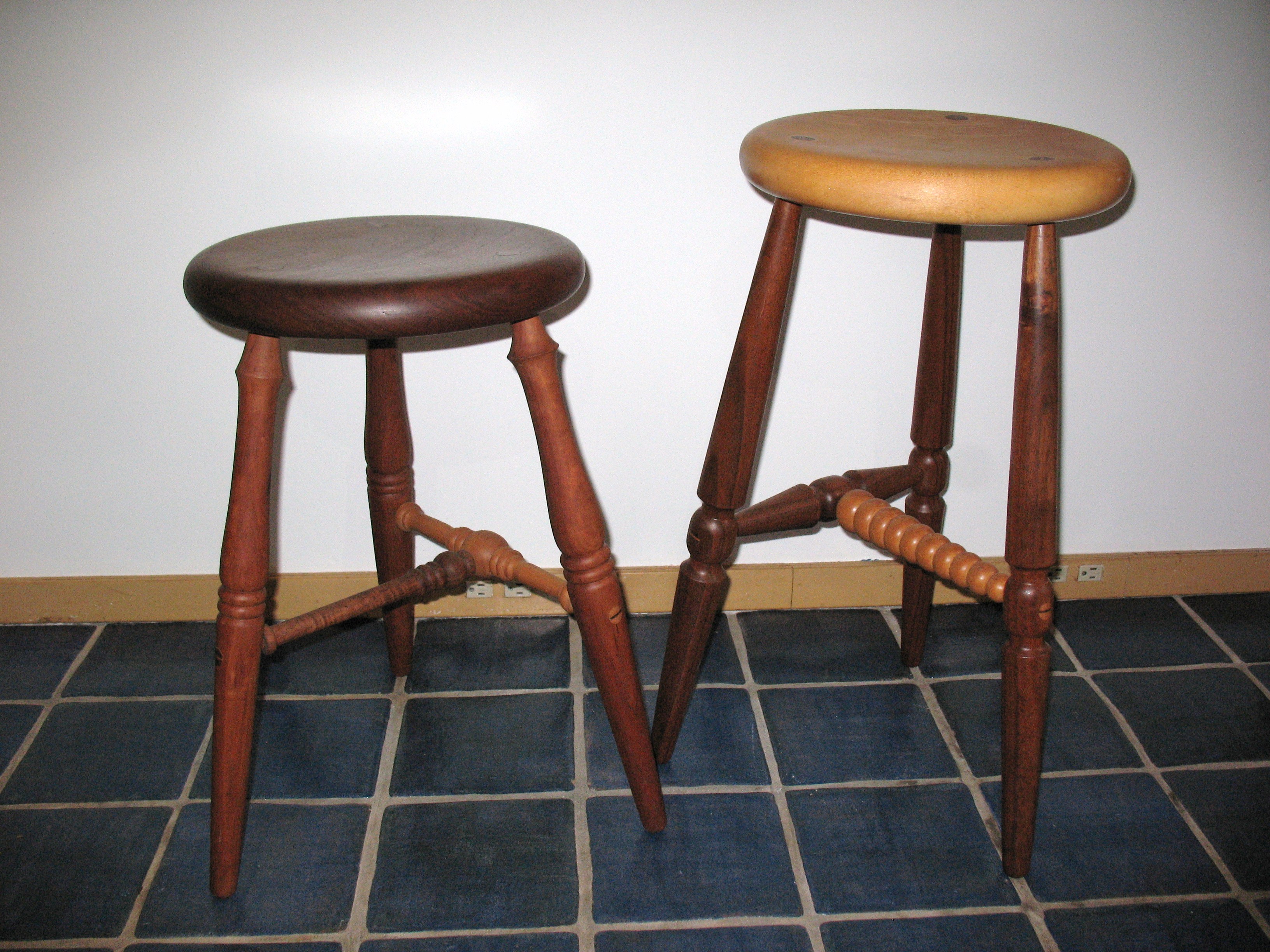
The stool on the left is made of walnut, cherry, and maple and is 23″ tall. The stool on the right is made of maple and walnut and is 28″ tall.
The stretchers are joined to the legs with straight through wedged mortise and tenon joints. I often use wedges of contrasting woods to emphasize the joinery.
The legs are joined to the seat using a tapered through wedged mortise and tenon joint. This means that the tenon is larger on the bottom than it is on the top. Thus sitting on the stool exerts force on the joint that would tend to tighten it rather than cause it to fail. (In practice, I don’t see this joint moving much in use.) I also use a wedge in these joints that is wider than the tenon. This keys the joint, making it resistant to failure from twisting.
This is a maple stool seat with walnut legs.
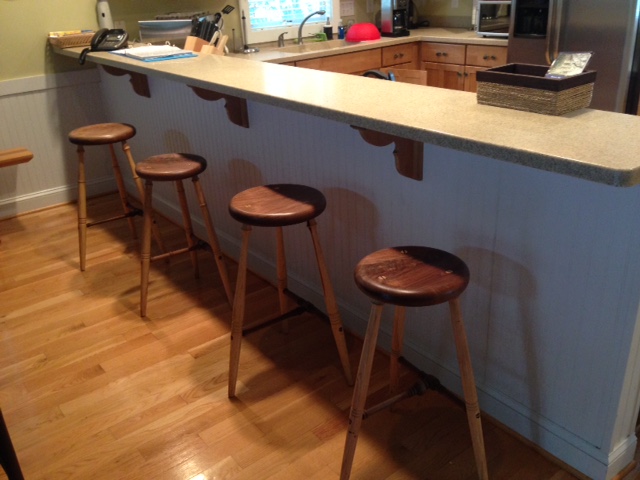
Here’s a set of stools made for a friend’s house at Bald Head Island.
Walnut seats and stretchers with hickory legs and wedges.







 Jimwallacewoodturning.com